by Aadil Cheema for Winter Film Festival
See the short comedy film Lazy White Cows (Vacas Brancas Preguiçosas) on February 19 @5:50PM at REGAL Union Square (850 Broadway) as part of New York City’s 14th Annual Winter Film Festival. Tickets now on sale!

This satirical comedy about racism in the digital realm moves at the breakneck speed of the internet while maintaining a clarity of thought and emotion that stays true to life.
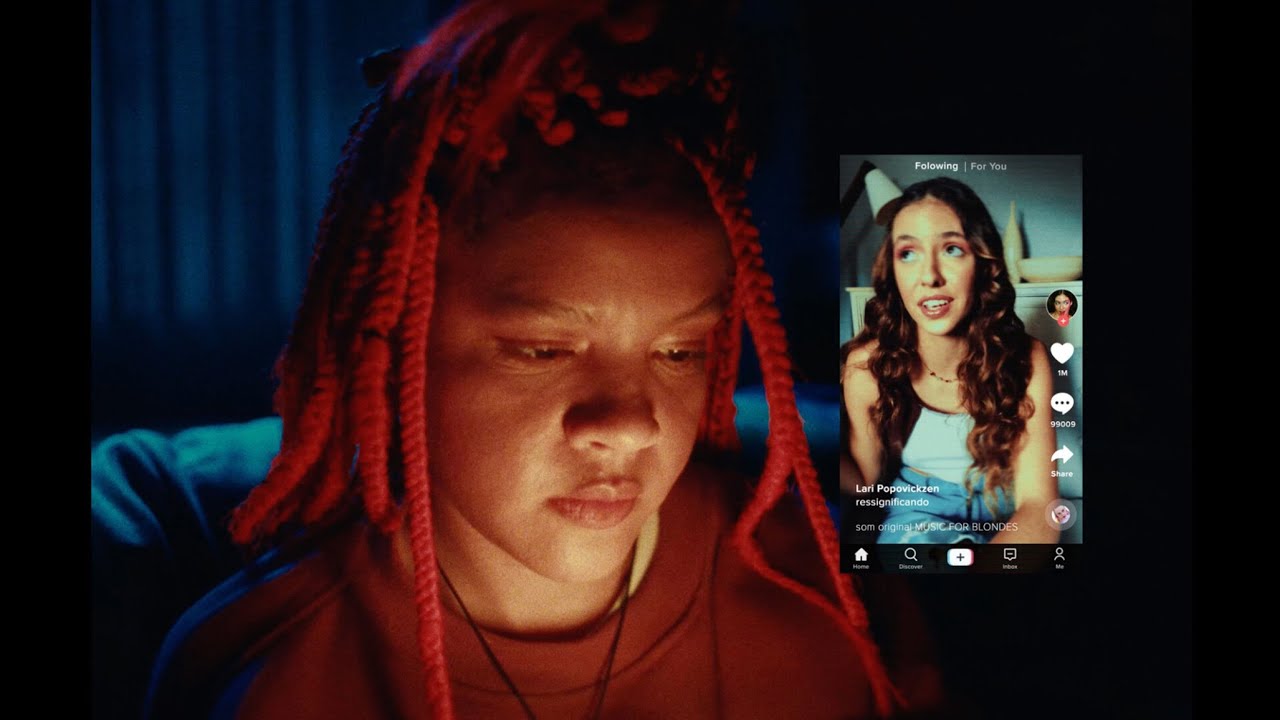
The proportion of our lives mediated by screens has increased dramatically in recent years, catalyzed by a global pandemic that shifted much of our work, school, and social lives to the virtual realm. Consequently, we’ve seen a proliferation of screenlife movies made by filmmakers interested in representing the aesthetics and sensations of life on the internet.
The subgenre is over ten years old and traverses multiple genres to varying degrees of success, but I’ve never seen one as inventive, unique, and propulsive as Lazy White Cows, a new short film from Brazilian writer-director Asaph Luccas. The Black, trans filmmaker depicts politics of race, class, and gender in a satirical comedy about a Black college student, Ster, who calls a classmate, Larissa, a “lazy white cow” then embarks on a virtual saga to avoid being canceled.
The premise is deliberately over the top, but it emerged from a very real incident. During the COVID-19 pandemic, Luccas’ younger sister had come to live with her and while she was in an online class, she muted her audio and, just like Ster, went on a rant about one of her classmates, picking apart the way they abused their privilege. “Most of the first monologue is exactly what she said on that day,” recalled Luccas. When writing the script, she also drew from broader cultural trends, specifically the disparity between how white and Black people in the public eye are treated, who has to jump through hoops to survive, and whom society is quicker to punish or forgive. “Just say sorry for the camera and everything will be fine as long as you’re white,” said Luccas, “but for black and queer people, we’re always already ‘canceled’ in society.”

In “Lazy White Cows,” Ster forgets to mute her microphone and her rant places her at the center of an internet frenzy. Her scholarship and matriculation are subject to suspension, putting her internship and ability to pay rent at risk. These are heavy consequences, but Luccas chose to translate the story through a comedic lens for a couple reasons. “We’re talking about digital racism, but for people that are not heavy internet users, it could sound a little superficial,” explained Luccas, “so I didn’t want to make the film take itself too seriously. It has a message, but we can laugh to it.” She appreciates the inviting power of humor to “open the doors and get people to talk on those subjects.”
Luccas is part of a long history of artists using comedy to criticize the absurdities of racism and classism, but her approach is refreshing because her characters get to join the fun. The actors portraying Ster’s two roommates interact like lifelong friends, joking around, talking over each other, answering questions before they are spoken, inventing slang in unison. There is a real intimacy and comfort to the way the three of them share the frame.
It is common for satires about race or class to generate laughs by subjecting their characters to discomfiting situations while the characters themselves rarely experience any joy. “Here in Brazil, we don’t have many queer films or many films that are black representation, and usually they are very dramatic and sad,” said Luccas, “so I wanted to make a film that my friends would see themselves in and have fun too.” Her community of friends, her chosen family, has been vital to Luccas’ survival, as is the case for many queer people of color. And they supported her throughout the post-production of “Lazy White Cows.”

The short is replete with fantastic visual effects deployed to evoke the digital world its characters traverse. The problem of how to make a text message exchange cinematic plagues any filmmaker trying to portray modern social life, and Luccas solved it with impressive originality. In the scene in question, Ster and Larissa are rendered as 3D digital avatars that float and spin around each other in a black void while their texts glow in neon letters behind them. To create the scene, Luccas scanned her actors with an app typically used to map rooms and gave the character models to a friend with experience in animation. Most of the movie’s VFX followed the same process: Luccas, who has a background in illustration and design, created the assets that her animator friends who “believed in the project” would use to craft the finished effects, free of charge. “I’m so grateful for them,” said Luccas.
It is a feeling that Luccas shares with her main character, Ster, who relied on her friends to help her survive, and will likely continue to rely on them as long as racism, classism, homophobia, and transphobia are part of the status quo. “I really wanted to showcase how their friendship was the thing that saved them,” said Luccas, “because I think this is the only thing that we actually have: each other.”
About Winter Film Festival
Winter Film Festival is an all-volunteer women and minority-run organization as part of Winter Film Awards Inc, a 501(c)3 organization founded in 2011 to celebrate emerging talent in local and international filmmaking.
The 14th Annual Winter Film Festival runs February 18-22 2026 includes a diverse mixture of animated films, documentaries, comedies, romances, dramas, horror films, music videos and web series of all lengths. Our five-day event is jam-packed with screenings and Q&A sessions at NYC’s REGAL Union Square, six Education sessions/workshops and a variety of filmmaker networking events all coming to a glittering close on February 22 with our red-carpet gala Awards Ceremony.
Winter Film Festival programs are supported, in part, by public funds from the New York City Department of Cultural Affairs in partnership with the City Council and are made possible by the New York State Council on the Arts with the support of the Office of the Governor and the New York State Legislature. Promotional support provided by the NYC Mayor’s Office of Media & Entertainment.
For more information about Winter Film Festival, visit WinterFilmFest.org
email us at info@winterfilmawards.com and visit us at Instagram, Facebook and Twitter.