by Sarai Browne for Winter Film Festival
See the feature thriller Accomplices on February 19 @8:55PM at REGAL Union Square (850 Broadway) as part of New York City’s 14th Annual Winter Film Festival. Tickets now on sale!

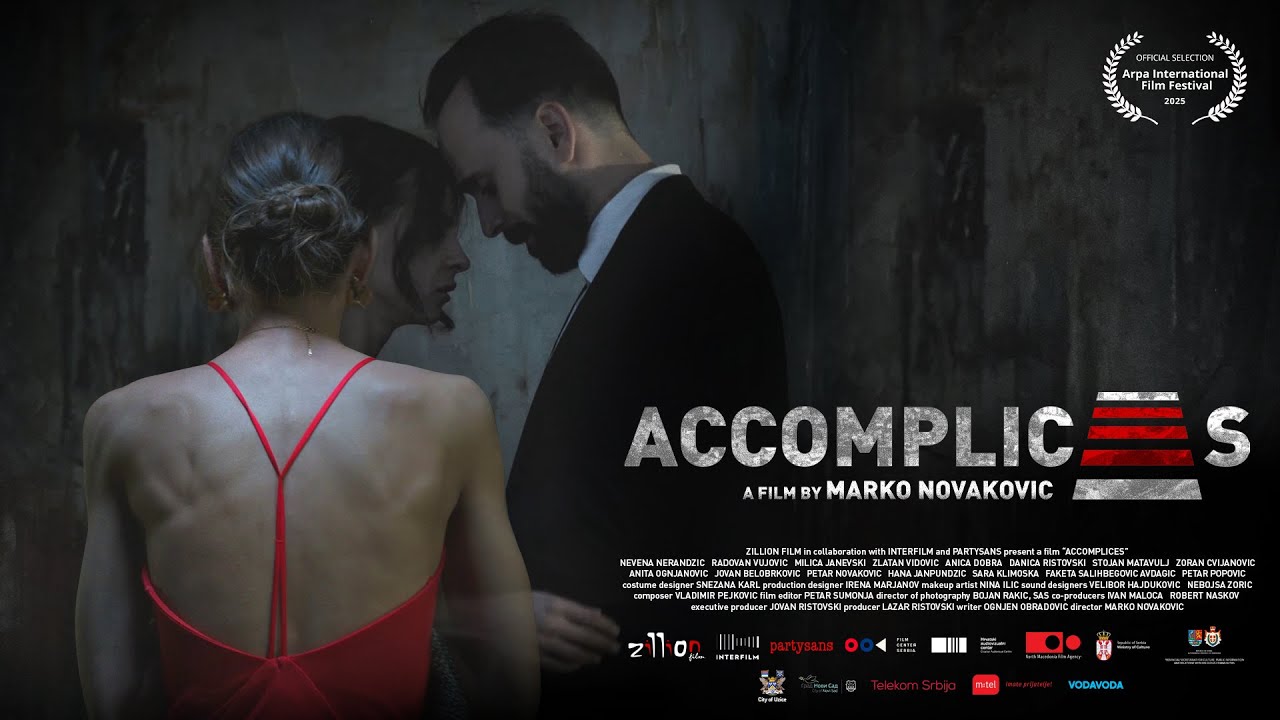
Accomplices examines how people and systems are shaped by individual choices. It’s an exercise in reflection and accountability, guiding you through your own emotional and moral terrain.
Some films resist easy interpretation because they ask us to watch differently. On the surface, Accomplices appears to be a typical psychological drama about guilt and corruption, with an open-ended resolution. With some reframing, it becomes an examination of how people and systems are shaped by individual choices that compound over time. The film is an exercise in reflection and accountability, demanding we think through decisions and consequences alongside its characters.
The film opens with newly engaged couple Sofija and Branko getting into a fatal accident on their way home from dinner. They choose to hide what happened, and that choice immediately locks them into a system of silence that the film explores throughout. From the outset, we are placed in a heavy, tense environment, with an undercurrent that builds to incoherence.
Emotional cues are withheld, conversations stay surface-level, and no one speaks honestly about what they feel. You wait for clarity that never comes, and without it, it’s hard to find your footing. The frustration builds. We are made to feel what it’s like to live in an environment where honest conversation is dangerous, and silence is required for survival. The only characters who speak freely are scrutinized and marginalized. Complicity perpetuates harm through the systematic avoidance of truth and accountability.
We are taken through a series of events that show how easily complicity forms through turning a blind eye, explaining things away, and quiet endurance. Sofija is our entry point into this world: the most naive, the least adapted, still struggling against what the older women have already learned to accept. Marko Novaković, the director, explains that “each of the female characters in our film belongs to a different layer on the social ladder, and each of them fights for their survival within the system in their own way.” But the system shapes everyone, including men, who use their own “fears and defense mechanisms” to create the “appearance of being in control”. The film shows how banal complicity creates corrupt systems that mold individuals to its needs, regardless of gender or position.

The most devastating example is Leposava, Sofija’s mother. When Sofija confesses to her mother, her face hardens, but she calls Branko instead of confronting the issue. We could read her expression as one of upset about her daughter’s grievances, but her actions suggest that the truth is too disruptive and its consequences too destabilizing. When forced to choose between her daughter’s version of events and an authority figure’s, she refuses to engage. All she says, to no one in particular, as Branko and Sofija are making their exit, is, “My daughter will freeze,” as she puts a sweater on her with a severe look.
You watch as this guts Sofija, and your heart breaks when you realize her mother has a greater allegiance to the system and survival than to her daughter. It isn’t a rejection, though it does show how harm perpetuates through the refusal to act or engage meaningfully. Novaković stressed viewers keep in mind that, “when people live in a society close to the poverty line, opportunities are much narrower compared to people from rich countries.” This context explains why the women might endure, why looking away becomes a survival strategy, and why complicity is easy to form when options are constrained.

Because you’re left unsettled, the film gives you a chance to process the experience yourself. Once you get over the initial shock of being denied resolution, you begin to ask what it all means. When the film ends, you’re angry, not only because you wanted a clean ending, but because Sofija deserves justice. But why? The director puts viewers through a moral test: “they become aware of the fact that an individual who has done something bad can still go unpunished if he sympathizes with the system that protects him, if he still adheres to the rules of that system.”
The film makes you feel the constraints the characters face. The impossible calculus of survival in a system with limited options. Would you make the same decisions? These questions aren’t rhetorical; they ask what principles govern your ethics and morals. Novaković wanted “the audience to leave the cinema with questions… to not only think about the problems or situations presented in the film, but to delve into the things that are close to them in their lives. I hope that the change within them is then externalized and manifested in the real world.”
Accomplices trusts you to do the work, offering activation rather than catharsis or moral clarity. The film guides you through your own emotional and moral terrain, but only if you allow it. Are you willing to do the uncomfortable work of sitting with what the film reveals about complicity and examining your own choices?
About Winter Film Festival
Winter Film Festival is an all-volunteer women and minority-run organization as part of Winter Film Awards Inc, a 501(c)3 organization founded in 2011 to celebrate emerging talent in local and international filmmaking.
The 14th Annual Winter Film Festival runs February 18-22 2026 includes a diverse mixture of animated films, documentaries, comedies, romances, dramas, horror films, music videos and web series of all lengths. Our five-day event is jam-packed with screenings and Q&A sessions at NYC’s REGAL Union Square, six Education sessions/workshops and a variety of filmmaker networking events all coming to a glittering close on February 22 with our red-carpet gala Awards Ceremony.
Winter Film Festival programs are supported, in part, by public funds from the New York City Department of Cultural Affairs in partnership with the City Council and are made possible by the New York State Council on the Arts with the support of the Office of the Governor and the New York State Legislature. Promotional support provided by the NYC Mayor’s Office of Media & Entertainment.
For more information about Winter Film Festival, visit WinterFilmFest.org
email us at info@winterfilmawards.com and visit us at Instagram, Facebook and Twitter.