by Ashley Cohen for Winter Film Festival
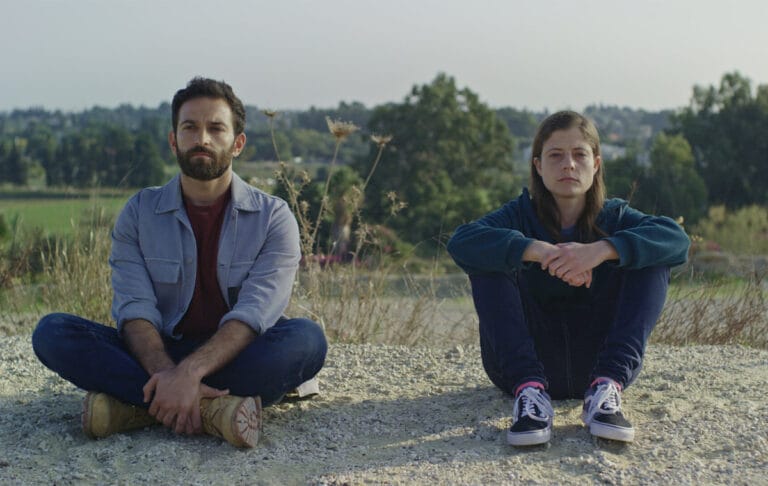
Short film The Cycle, directed by Arpita Mukherjee, is an official selection of New York City’s 14th Annual Winter Film Festival.

It’s hard for anyone to practice self-care, especially when you are drowning in your responsibilities as a wife, mother, daughter-in-law, and friend with no one letting you take a breath for yourself.
There is a well known saying that the more specific a story is, the more universal it becomes. The short film, The Cycle is about a housewife named Preet in Chandigarh, India and her journey of joining the city’s robust cycling community. Preet restricts herself to only peeled almonds and a one-meal-a-day (OMAD) diet as a way for her to lose weight and reclaim a sense of control over her life.
No one in the household is supportive of her decision, especially her passive aggressive mother-in-law. While her husband seems to be somewhat encouraging, saying he loves his “chubby wife,” he would rather she prioritize making carrot pudding for himself and his friends rather than taking time to see her friend. But she still wants to make time for herself, and goes to see a high school friend that she hasn’t seen in a while at a cycling meetup. Everyone is dressed in biker shorts, t-shirts, and tank tops; except for Preet who wears more traditional Indian attire. She just can’t seem to fit in anywhere she goes, something that crosses any cultural boundary.
One of the themes of the short is learning to navigate through the noises of societal expectations and finding your own voice underneath it all. On the surface, it is a story about Preet wanting to lose weight. However, writer-director Arpita Mukherjee explains that the initial goal, “is sort of a ruse… [Preet] learns the weight she needs to lose is one of expectations and patriarchy.” Mukherjee cites her favorite type of narrative is one where the character’s wants changes over the course of the story. There is a journey of the character realizing that she really wants something deeper than just a different physical appearance.

While Preet doesn’t receive any familial support to take some much needed time for herself, there is a character who constantly claims to be in her best interest, the faceless wellness influencer that speaks to her through her headphones. Mukherjee describes this as, “almost a voice in her head, that no one else can hear.” It is also a completely one-sided relationship, another authoritarian voice telling Preet how to live, until she finally reaches her breaking point.
Filming in India was Mukherjee’s biggest challenge and also the best part of the film. She describes the approach to working across the world as “beautiful” and “anarchic.” There was a moment where life imitated art during filming. There is a scene where two men on a bike harass Preet and her friend. While preparing to film the scene, two actual men on a bike randomly came up to the actresses and hollered out to them. Filming outside always brings the challenge of dealing with nonactor pedestrians (in this case bikers) crossing through the set. In this case Mukherjee saw it as more affirming than disruptive, “proof the film is an authentic portrayal of modern India.” When things got chaotic (working at odd hours, equipment issues, overall delays) she would of course adapt to the situation at hand. She also trusted the process and submitted to, “a sense of inevitability, that we would get somehow to the result we wanted.” An official selection for nine different film festivals, it’s safe to say that the making of The Cycle was successful.

Nearly all of the cast and crew on this short are based in India. Renowned filmmaker Rahul Chittella, helped to assemble the department heads for the crew. Mukherjee describes their contributions as “[taking] the film so much further.” A notable example of the film’s collaborative craft is the scene where Preet’s long-contained desire for autonomy culminates in a dance sequence. It is a beautiful mix of editing, sound design, score, camera work, props as her independence finally breaks through.
Mukherjee’s work in theatre helped to inform how she approached that sequence. She is the co-founder and artistic director of Hypokrit, a production company that elevates diverse stories from the global majority, particularly those of South Asian descent. She most recently directed theatrical performances of the variety comedy How I Met Your Masi, and the solo show Unknown Unknowns, amongst many others. Something that film and theater have in common is a focus on “pace and flow,” Mukherjee said. The short itself is about seventeen minutes and this dialogue-free climatic dance sequence is less than a minute long. So much is said through the camera work and performances in such brief moments without ever feeling rushed.
About Winter Film Festival
Winter Film Festival is an all-volunteer women and minority-run organization as part of Winter Film Awards Inc, a 501(c)3 organization founded in 2011 to celebrate emerging talent in local and international filmmaking.
The 14th Annual Winter Film Festival runs February 18-22 2026 includes a diverse mixture of animated films, documentaries, comedies, romances, dramas, horror films, music videos and web series of all lengths. Our five-day event is jam-packed with screenings and Q&A sessions at NYC’s REGAL Union Square, six Education sessions/workshops and a variety of filmmaker networking events all coming to a glittering close on February 22 with our red-carpet gala Awards Ceremony.
Winter Film Festival programs are supported, in part, by public funds from the New York City Department of Cultural Affairs in partnership with the City Council and are made possible by the New York State Council on the Arts with the support of the Office of the Governor and the New York State Legislature. Promotional support provided by the NYC Mayor’s Office of Media & Entertainment.
For more information about Winter Film Festival, visit WinterFilmFest.org
email us at info@winterfilmawards.com and visit us at Instagram, Facebook and Twitter.