by Cristina Slattery for Winter Film Festival
See the NYC Premiere of the documentary short I Am Here You Are Not I Love You on February 22 @12:15PM at LOOK Cinemas (657 West 57th Street) as part of New York City’s 13th Annual Winter Film Festival. Tickets now on sale!
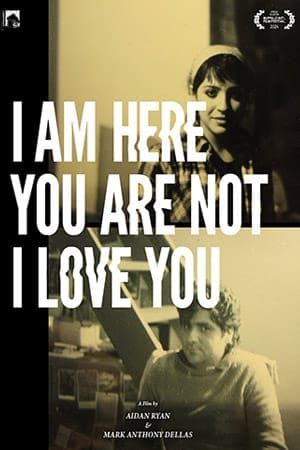
People who have a plan B will use it,” Aidan Ryan, a writer and author of a forthcoming book about his aunt and uncle, both artists, says his high school Spanish teacher once told him. Ryan’s book, I Am Here You Are Not I Love You, which is also the title of a short documentary film he’s made about his uncle and aunt, will be published by the University of Iowa Press this spring.
This first foray into filmmaking, approximately forty minutes in length, focuses on Andy Topolski and Cindy Suffoletto, who passed away in 2008 and 2012, respectively. Topolski, a decade Cindy’s senior, met the young artist, Ryan’s mother’s sister, in Buffalo, New York, where they were both from, and where she was studying. The two were inseparable, eventually leaving Buffalo’s art world to move to New York in the mid-1980s.
Ryan, their nephew, says that “it starts with the art,” and images of both Cindy’s and Andy’s work are part of the initial scenes of the film. Although there is some footage of the couple in the film, their nephew explains that he only had a certain amount of footage of the two of them that he could use. Other scenes include interviews with art world friends of the couple and some of Ryan himself looking at Andy’s artwork and seemingly attempting to understand it. Making this film was painful for Ryan because he had been close to Andy and Cindy; they were his first models for how to build an artistic life, he says. Ryan adds that his aunt and uncle were always interested in him as a child and that the couple made “an enormous impact on all of their close friends.” According to Ryan, Andy’s and Cindy’s Brooklyn apartment was a gathering place for those in the art world in the late 1980s through the early 2000s, when the couple moved to their home in the Catskills full-time. Ryan states that “once you got close to Andy,” his dark sense of humor was evident, and that he was “playful, and convivial,” but that “Andy was not an optimistic person.” In contrast, Cindy, as shown in the film, and also as described by her nephew, was petite and had a “warm and magnetic presence.”

Topolski’s work started to become well-known after the couple moved to New York, but it still wasn’t feasible for both to be full-time artists, Ryan explains when we discuss the film, and Cindy took on the role of breadwinner. One person interviewed in the film observes that Cindy sacrificed a lot for the relationship – the last exhibition of her own work was held back in 1993. She worked as an office manager of an architecture practice and had some other roles as well. Some of the architects Cindy worked with became patrons of Andy’s work, and there was some overlap between their two professional worlds, but Cindy was consistently working in corporate-type of jobs for fifteen years. As Andy’s star rose, Ryan explains, his work was featured in more prestigious exhibitions, one of which was “A Century of Drawing” in Washington D.C.’s National Gallery of Art. There Topolski’s drawings were exhibited alongside much more celebrated artists such as Picasso and Sol LeWitt.
The film portrays the vibrant art scene that existed in Buffalo in the 1960s and 70s, but viewers also learn that the western New York city’s declining economy in the 1970s made it challenging for artists in Buffalo to find patrons for their work. Ryan emphasizes, when we speak, that Andy was influenced by the Fluxus movement in which artists used sounds, texts, everyday objects, and often mocked the seriousness with which other artists took themselves. He states that Topolski was particularly inspired by the German artist, Joseph Beuys, who became prominent in the 1960s and 70s. Ryan also tells me that Andy had begun focusing on art as a child because of a stutter that made it difficult for him to communicate verbally and thus visual art became a means of expression for Andy and it was clear from a young age that he was gifted.

Cindy and Andy were “two people who were deeply in love with each other,” according to their nephew, but, as others interviewed in the film indicate, those in the art circles of the late 20th and early 21st century often didn’t even know that Cindy was an artist herself because of her dedication to Andy’s career. After 9/11, an event that both Andy and Cindy experienced, and that caused Andy to become even more pessimistic about society, according to Ryan, the couple permanently left New York to settle in their home that had been a weekend getaway in the hamlet of Callicoon in the Catskills, about two-and-a-half hours from the city. We see footage of this home in the film and Ryan says that this small village of farmers, townies, artists, and a few celebrities, too, was an oasis for the two of them in the years before Andy’s passing in 2008.
Although Andy couldn’t consistently create until 2003, Ryan says, after he became paralyzed, in a sense, in the aftermath of 9/11, he did end up submitting a proposal for the 9/11 Memorial, which ultimately wasn’t chosen. The film shows us images of this proposal and also one for the Buffalo airport that Topolski was particularly upset wasn’t chosen. Topolski’s early 2000s pieces included more organic material – one shown has an animal skull, for example. His work, which had been previously characterized by “clean shapes, clean lines,” “scattered letters and numbers” “references to cartography, physics, and chemistry,” as Ryan relates, now was dramatically different. Andy, who had been teaching at Parsons School of Design on 9/11 and helped evacuate the school that day, dressed in all black after the terrorist attacks, and his work reflected a more cynical view of the world, mass media, and political leaders as well, Ryan adds.

Andy died in 2008 and Cindy, at age 50, four years later. Their nephew, though, would like to see them exhibited together in the future. This documentary, he hopes, will allow those who knew them, as well as newer audiences who aren’t familiar with their work, to learn about their life and contributions. Ryan notes that although his aunt was grieving after Andy’s passing, she also seemed to be able discover herself as an artist again in the years she was a widow, before her own passing in 2012. The art that she left at the house in Callicoon, that Ryan and other family members cleaned out after Cindy had passed away, looked as if she had been “producing as if she had never taken a break,” Ryan says. There is an entire series of 50 works from Callicoon, many of which include images of Cindy from an inkjet printer, twine, twigs, fish scales, cicadas, and one of which includes a decomposed bird, that we are shown towards the end of the film and viewers also mourn the loss of what both artists could have created had they been given more time on this planet. Ryan hopes both Cindy and Andy will be recognized for the beautiful love story they shared, the positive impact they made on those they encountered, and their legacies in art, and this film is a touching tribute to their story together.

About Winter Film Festival
New York City’s 13th Annual Winter Film Festival runs February 19-23 2025 includes 87 outstanding films, a diverse mixture of animated films, documentaries, comedies, romances, dramas, horror films, music videos and web series of all lengths. Our five-day event is jam-packed with screenings and Q&A sessions at NYC’s LOOK Cinemas, six Education sessions/workshops and a variety of filmmaker networking events all coming to a glittering close on February 25 with our red-carpet gala Awards Ceremony.
Winter Film Festival is dedicated to showcasing the amazing diversity of voices in indie film and our 2025 lineup is half made by women and half by people of color. Filmmakers come from 20 countries and 30% of our films were made in the New York City area. 15 films were made by students and 26 are works from first-time filmmakers.
Winter Film Festival programs are supported, in part, by public funds from the New York City Department of Cultural Affairs in partnership with the City Council and are made possible by the New York State Council on the Arts with the support of the Office of the Governor and the New York State Legislature.
Visit https://winterfilmfest.org/wff2025/ for more information.