by Ashley Cohen for Winter Film Festival
See the feature film Method to My Madness on February 19 @8:30PM at REGAL Union Square (850 Broadway) as part of New York City’s 14th Annual Winter Film Festival. Tickets now on sale!

Made independently and in secret, the Iranian film “Method to My Madness” exists as an act of resistance. The film explores the gap between what we present to others and who we truly are.
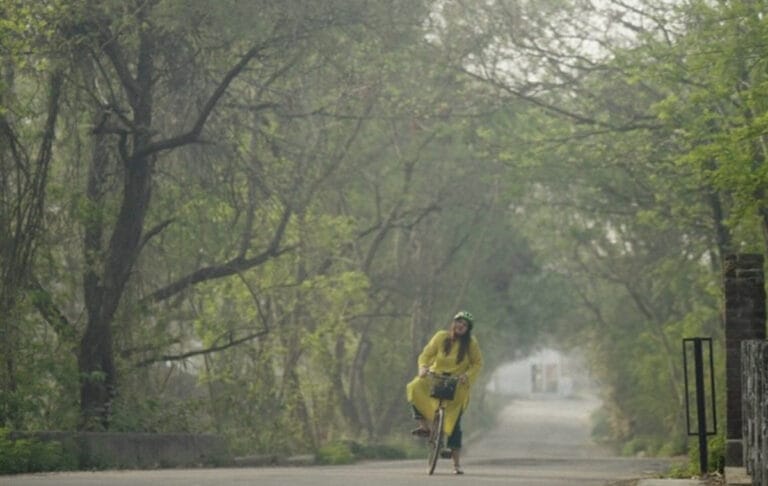
The film is about a videographer named Kamand who accepts a gig with a strange request. She is to go to a house in a remote area to document two women – Tina and Nazy – on their final night living together before Nazy moves away. They are best friends. Roommates. Maybe something more than just roommates. Tina wants this last night to be immortalized, so she tells Kamand to film “just us, being us.” Method to My Madness becomes a search for that authenticity, what it truly means to be oneself. As the night unfolds, the audience continually questions who these three characters really are. What is performative, and what is the truth underneath?
In a way, this movie is similar to the Apple+ series, Severance. Both explore the disconnect between a work-self (the part of you that has to be ‘on’ for the sake of getting a job done) and a personal-self (the part of you that exists when no one is watching). Early on in the film, we see Kamand parked in her car, checking her makeup before going into the house. Writer-director Behrang Mortazavian says that, “it represents the first moment of masking: the transition from one’s private self into a social role. The body becomes the first site of censorship. This shot is less about appearance and more about preparing to perform.” Later, when Tina and Nazy start asking Kamand personal questions, she gives neutral, passive responses. She understates her uncomfortability while the two other women seem to thrive in it. They know they are being filmed but literally dance (there are many dance sequences and singing in the film) like no one is watching. But are they really as free as they may seem?
Mortazavian lives within this tension of outward appearances versus authenticity everyday in Iran. He wrote a cathartic script where there is a, “suffocating atmosphere that reflects characters living under constant pressure and danger, forced to perform roles imposed on them, while still struggling to remain themselves.” The inner conflict of what one presents to the world versus the reality also specifically relates to present-day Iranian cinema. As Mortazavian explains, “The government actively promotes an officially approved image of Iranian cinema and aggressively suppresses alternative voices. Being able to make this film and bring it to audiences is, for us, an act of authenticity in itself.” This broader context adds an additional layer of meaning to the film.

In the United States, freedom of speech and freedom of expression are often taken for granted. Throughout most of the film, the women do not wear head coverings. While that might not seem like a shocking statement, that is considered a criminal act in Iran. The cast and crew faced a real danger of imprisonment in pursuing this project. Mortazavian prioritized safety by working within certain constraints. With a limited budget, the entire film was shot in about six days. Most of the scenes take place in one house or inside of a car. Being confined to interiors actually lended itself to that claustrophobic, trapped feeling that all the characters have.
There are many long takes in the film. This likely maximized how much filming can get done per day, but it also helped with establishing an eerie tone. These long takes are interspersed with jump cuts, a jarring editing technique where there is an abrupt ‘jump’ between similar shots of the same subject. While many editing styles try to be invisible, the jump cut is very noticeable, causing a disjointed effect. Ever so slight differences of the camera framing or the character’s movement become unsettling and impossible to ignore. Mortazavian contrasts the long takes with the jump cuts “deliberately to deny the viewer a sense of comfort…and heightens insecurity.”
The jump cuts also symbolize the unreliability of memory and how the truth can be fragmented. While a camera can record everything and replay it exactly how it happened, the mind is less perfect. As Kamand documents the night, Tina admits that she already misses Nazy. But Nazy has not left yet, she’s just off camera in the other room. Despite paying to have the night recorded for posterity, Tina still is not fully present. The jump cuts are a visualization of how the mind can wander and then quickly snap back to the present moment, where seconds or even minutes are forever lost to time. Mortazavian describes Tina’s feelings as, “the fear of an unknown future…casting a shadow over even the most intimate moments.” He suggests the solution is, despite the fear, to live truthfully in the present.

Even though there is a lot of uncertainty about the situation in Iran, Mortazavian remains hopeful for the future of Iranian cinema. He says that other underground Iranian filmmakers are also “finding ways to create without financial support, without permission, and despite serious personal risks.” He defines real cinema as “begin[ning] with lived experience using our own reality, holding onto our own dreams, and fighting for them.” Method to My Madness could not have been made without trust among its cast and crew. They were all taking huge personal risks in order to tell this story. From the other side of the world, it may seem like madness to put yourself in a situation that may jeopardize your entire life. But when life is so uncertain, the only way to live is to methodically stay true to yourself.
About Winter Film Festival
Winter Film Festival is an all-volunteer women and minority-run organization as part of Winter Film Awards Inc, a 501(c)3 organization founded in 2011 to celebrate emerging talent in local and international filmmaking.
The 14th Annual Winter Film Festival runs February 18-22 2026 includes a diverse mixture of animated films, documentaries, comedies, romances, dramas, horror films, music videos and web series of all lengths. Our five-day event is jam-packed with screenings and Q&A sessions at NYC’s REGAL Union Square, six Education sessions/workshops and a variety of filmmaker networking events all coming to a glittering close on February 22 with our red-carpet gala Awards Ceremony.
Winter Film Festival programs are supported, in part, by public funds from the New York City Department of Cultural Affairs in partnership with the City Council and are made possible by the New York State Council on the Arts with the support of the Office of the Governor and the New York State Legislature. Promotional support provided by the NYC Mayor’s Office of Media & Entertainment.
For more information about Winter Film Festival, visit WinterFilmFest.org
email us at info@winterfilmawards.com and visit us at Instagram, Facebook and Twitter.