by Despina Afentouli for Winter Film Festival
See the the short film A Good Day Will Come on February 19 @8:30PM at REGAL Union Square (850 Broadway) as part of New York City’s 14th Annual Winter Film Festival. Tickets now on sale!
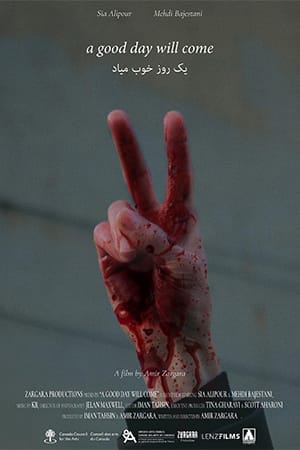
Stories that resist. Art that matters. Dr. Despina Afentouli in conversation with filmmaker Amir Zargara on A Good Day Will Come—a timely film driven by injustice, artistic courage, and moral urgency.
This interview was conducted on Dec 27, 2025. People of Iran are in our thoughts.
Q: What inspired you to produce this film, and how did the script evolve from your original concept?
The inspiration for the film comes from Navid Afkari. I followed his case closely, and when I learned of his unjust execution, it deeply shook me. At the time, I assumed that another Iranian filmmaker—someone with more distance, stature, or resources—would eventually take on his story. I waited nearly two years, but no one did.
Initially, I wasn’t sure I wanted to tackle it myself. Making any film is difficult, but making a film about your own people is even harder—it carries an added weight, responsibility, and inevitable criticism. Over time, I came to realize that I have a privilege many inside Iran do not: the freedom to tell this story. That realization transformed the project from a creative impulse into a sense of duty, and once that clicked, I fully committed.
The script went through a major evolution. My first approach was a docu-drama, developed in collaboration with a writer experienced in that form. While the script was structurally solid, I felt it didn’t allow me to build the level of empathy I wanted—for the characters, and more importantly, for the people of Iran living under these conditions. It felt constrained by the form.
Ultimately, I made the difficult decision to abandon that version and reimagine the story as a fictional narrative where the lead character is inspired by Navid. That shift gave me the emotional and dramatic freedom to explore deeper truths rather than strict facts—and that process led to the film you see today.

Q: Your film is inspired by the tragic events surrounding Iranian wrestler Navid Afkari. Why was it important for you to tell a story based on these real-world events rather than a purely fictional one?
It was important to ground the story in real-world events because what happened to Navid Afkari is not an isolated tragedy—it reflects a broader reality that many people in Iran continue to live under. Anchoring the film in that truth gives the story emotional and moral weight, while reminding audiences that the stakes are real, not abstract.
At the same time, I wasn’t interested in recreating events beat by beat. Using a character inspired by Navid allowed me to stay faithful to the spirit of what happened while creating space to explore the human cost—fear, dignity, resistance, and impossible choices. The real-world foundation ensures the film carries authenticity, while the fictional framework allows it to reach a deeper emotional truth rather than functioning as a documentary.
Q: The protagonist, Arash Jafari, says: “I wouldn’t be able to live with myself, knowing that I did nothing.” How would you describe his personality? Do you believe his values represent the essential qualities of a modern-day hero?
I would say that line reflects exactly how I felt when I was deciding whether or not to make this film. It felt as true to me as it does to the character. Arash isn’t driven by ego or a desire to be a symbol—his motivation is deeply personal. He wants to ensure that his younger brother has a better future, but he approaches that responsibility in a measured way, always keeping the well-being of his family in mind.
I wouldn’t define what a modern-day hero should or shouldn’t be. For Arash, his actions emerge out of circumstance rather than ambition. After the incident, it felt inevitable that he would arrive at this point—especially considering that he is following in his father’s footsteps, who made a similar moral choice before him. In that sense, Arash’s values aren’t about heroism as an ideal, but about conscience, responsibility, and the inability to look away.

Q: The ideal of “freedom” has been tested throughout history. From your perspective as a filmmaker, how have the challenges of human rights protection changed today compared to the past?
The challenges around freedom and human rights haven’t disappeared—they’ve changed shape. In the past, oppression was often more visible and overt. Today, it’s frequently more systemic, normalized, and disguised through bureaucracy, surveillance, and control over information. Power doesn’t always rely on force alone anymore; it operates through fear, economic pressure, misinformation, and isolation.
As a filmmaker, what feels different now is how quickly injustice can be seen—and how quickly it can also be forgotten. We live in an age of constant exposure, but attention is fleeting. Images circulate, outrage spikes, and then the world moves on. That creates a new kind of challenge: not just revealing injustice, but sustaining empathy.
Cinema still has a role to play here. Film can slow us down. It can take what feels distant or overwhelming and make it intimate and human. Rather than debating freedom as an abstract idea, storytelling allows us to experience what its absence does to a single life, a family, or a community. For me, that’s where film remains powerful—not as a solution, but as a reminder of what’s at stake.
Q: How long was the production process? From the initial development to the final cut, what were the most significant challenges you overcame, and which moments during the process felt the most rewarding?
Once I committed to telling the story through a fictional lens, the first draft came together relatively quickly—within a few months. That draft continued to evolve into the film you see today. From there, the process slowed down in a very real way: we applied for grants, which meant waiting six to eight months just to hear back.
Once we received the green light, the biggest challenge became figuring out where we could realistically shoot the film. I spoke with production companies in several countries that often double for Iran—Greece, Georgia, Jordan, Morocco, Turkey, and Italy—but every option was simply too expensive given how ambitious the script was. Eventually, through a conversation with an established filmmaker in Iran, I was introduced to Iman Tahsin. We met in early January, and just eight weeks later, we were in production.
By that point, casting had already taken close to six months. I had cast Sia Alipour and Mehdi Bajestani while simultaneously trying to determine the shooting location, which made everything more complicated. Once we wrapped principal photography—which lasted six days—we moved directly into post-production, and a few months later we had our final cut.
Honestly, the entire process felt challenging. Casting Arash was by far the hardest part. We didn’t have the resources to train someone physically or teach wrestling, so we needed an actor who already had that background, spoke Farsi, lived outside of Iran, was willing to risk not being able to return, and was the right age. At every stage, the pool of actors became smaller and smaller, until Sia was essentially the only person who checked every box—and thankfully, he said yes. Without him, there is no film.
After that, the biggest hurdle was location. Once Iman came on board, he handled things with incredible care and precision, making sure every department was covered and that we could move forward safely and confidently.
One of the most rewarding moments was shooting the protest scene. It was filmed in a single day and went almost entirely without hiccups. All the preparation and rehearsals really paid off at that moment.
Other moments that stay with me are the first time I showed the film to my parents, and the first time I experienced it with a live audience. And of course, winning the Golden Egg Award at the Reykjavík International Film Festival in front of a large crowd was incredibly meaningful—it felt like a moment of collective recognition for everything that went into making the film.

Q: Could you tell us more about the film’s scoring? How did you use music—specifically the Middle Eastern instrumentation—to heighten the emotional stakes for Arash?
From the beginning, I knew I wanted the kamancheh—a Persian string instrument—to be central to the score. It carries a deep emotional weight and feels inseparable from Arash’s inner world. I had a few musical references in mind, and Iman suggested a composer friend in Iran who he felt could capture that tone.
We reached out, shared the references, and what he delivered exceeded everything I hoped for. The score became one of my favorites I’ve worked with to date. It doesn’t tell the audience what to feel—it breathes with Arash, heightening the emotional stakes without ever overwhelming the story.
Q: Your title is A Good Day Will Come. What does a “good day” look like for you? In 2026, do you remain an optimist, and what is the primary message you hope international audiences take away from this story?
It might be due to my age or a certain sense of naivety, but I genuinely believe that a good day will come—and I hold onto that hope. For me, a “good day” is one where I can return to Iran and make films like this freely, where people can live without fear, and where the country exists under a democratic, secular system. Despite everything, I remain an optimist, because without that belief, telling stories like this wouldn’t be possible.
About Winter Film Festival
Winter Film Festival is an all-volunteer women and minority-run organization as part of Winter Film Awards Inc, a 501(c)3 organization founded in 2011 to celebrate emerging talent in local and international filmmaking.
The 14th Annual Winter Film Festival runs February 18-22 2026 includes a diverse mixture of animated films, documentaries, comedies, romances, dramas, horror films, music videos and web series of all lengths. Our five-day event is jam-packed with screenings and Q&A sessions at NYC’s REGAL Union Square, six Education sessions/workshops and a variety of filmmaker networking events all coming to a glittering close on February 22 with our red-carpet gala Awards Ceremony.
Winter Film Festival programs are supported, in part, by public funds from the New York City Department of Cultural Affairs in partnership with the City Council and are made possible by the New York State Council on the Arts with the support of the Office of the Governor and the New York State Legislature. Promotional support provided by the NYC Mayor’s Office of Media & Entertainment.
For more information about Winter Film Festival, visit WinterFilmFest.org
email us at info@winterfilmawards.com and visit us at Instagram, Facebook and Twitter.